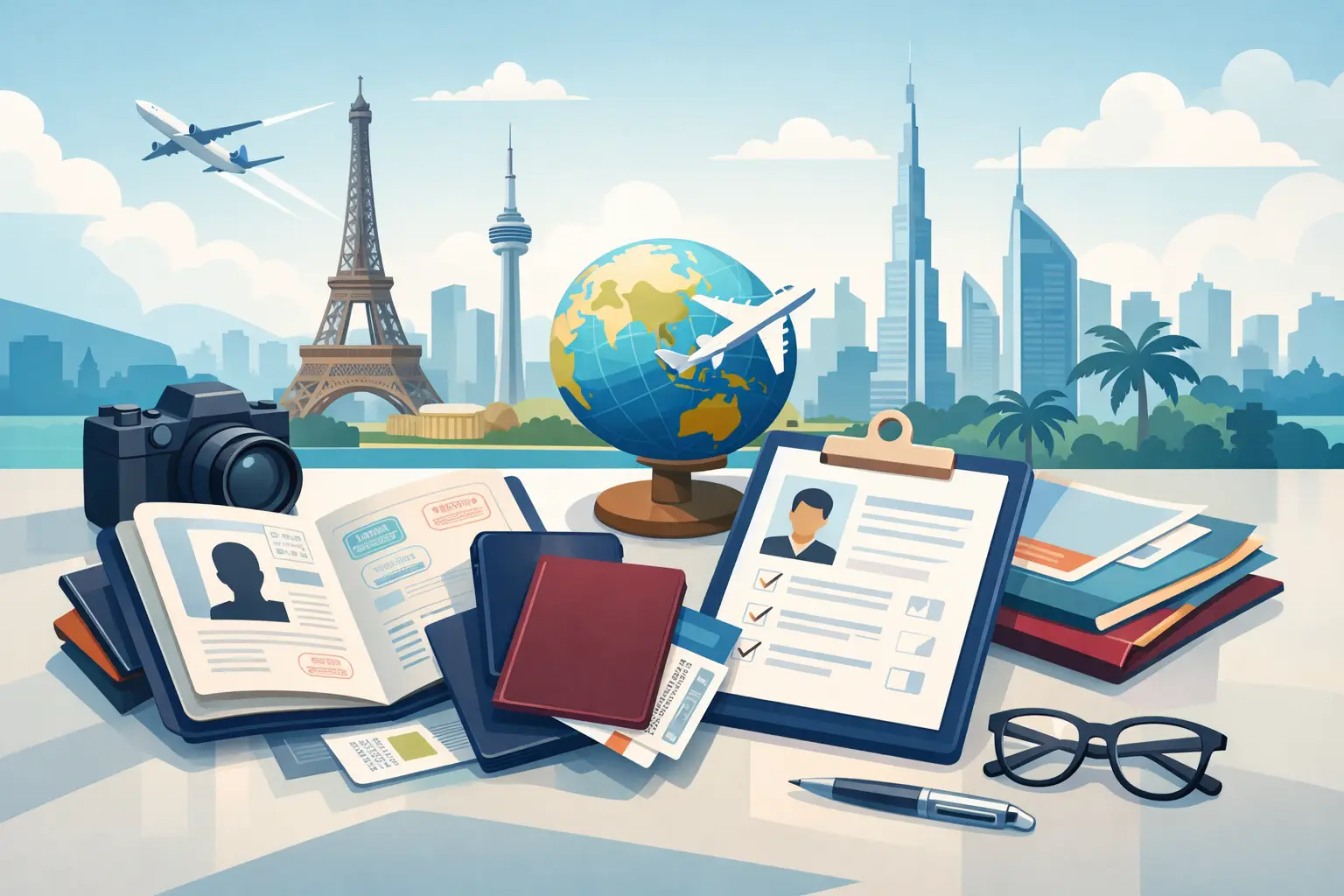
A visa application can look straightforward until one missing document delays the entire trip. If you have been asking what documents are needed for visa approval, the honest answer is that there is a standard foundation, then a second layer that depends on your destination, passport, and purpose of travel.
That is where many travelers get caught out. They prepare what feels obvious - a passport and a form - but overlook the documents that prove finances, ties to home, travel intent, or sponsorship. For Nigerian and Ghanaian passport holders in particular, consulates often expect an application that is not only complete, but clearly organized and credible.
What documents are needed for visa applications?
Most visa applications start with the same core set of documents. These usually include a valid passport, a completed visa application form, recent passport photographs, proof of travel plans, proof of accommodation, and evidence that you can financially support the trip. In many cases, you will also need supporting papers such as employment letters, bank statements, tax records, invitation letters, or proof of legal residence if you are applying from a country that is not your country of citizenship.
The exact list depends on the visa type. A tourist visa does not require the same paperwork as a business, student, family visit, or conference visa. A Schengen application may ask for travel insurance and a detailed itinerary, while a U.S. visa application often focuses more heavily on your background, travel purpose, and interview responses. A UK application may look closely at your financial history and the source of funds in your account.
That is why there is no single universal checklist that works for every destination. There is, however, a reliable way to think about visa documents: identity, purpose, finances, travel arrangements, and ties to your place of residence.
The core documents most embassies expect
Your passport is the starting point. It generally needs to be valid for at least six months beyond your planned travel dates, although some countries apply different rules. Many embassies also require blank visa pages. If your passport is damaged, loose, or close to expiry, it can create avoidable issues before your application is even reviewed.
The application form must match your supporting documents exactly. Names, passport numbers, travel dates, employer details, and address history should be consistent. Small discrepancies are often treated as carelessness, and repeated inconsistencies can raise concerns about credibility.
Photographs are another detail applicants underestimate. Visa photo rules are not interchangeable. A photo used for one country may not meet the size, background, or expression requirements for another. This is a small document, but it can still cause delays.
Proof of travel usually means a flight reservation or itinerary, not always a fully paid ticket. Some embassies want to see proposed entry and exit dates. Others want a more complete route, especially if you plan to visit several countries. Proof of accommodation can include hotel bookings, an Airbnb confirmation where permitted, or a host invitation if you are staying with family or friends.
Financial documents are often where decisions become more nuanced. Bank statements are commonly required, but they are rarely judged by balance alone. Officers may review consistency of income, spending patterns, large recent deposits, and whether the account activity supports the purpose and duration of the trip. A strong application is not just about having money in the bank. It is about showing that the money is genuinely yours, stable, and sufficient.
What documents are needed for visa approval by travel purpose?
Purpose matters. If you are traveling for tourism, the embassy usually wants to see that your trip is temporary and well planned. That often means a travel itinerary, hotel reservations, proof of employment or business activity, and financial evidence.
If you are visiting family or friends, the supporting documents may include an invitation letter, a copy of the host's passport or residence permit, proof of address, and sometimes evidence of your relationship to the host. In some countries, the host must provide formal sponsorship papers rather than a simple letter.
For business travel, expect to submit a letter from your employer and an invitation from the company you are visiting. These should align on dates, purpose, and who is covering costs. If there is a conference, exhibition, or corporate meeting involved, registration evidence can help reinforce the reason for travel.
For students, documentation typically becomes more extensive. Admission letters, tuition payment receipts, academic records, proof of funds, and sometimes medical or police clearance certificates may be required. The same applies to work visas, where contracts, employer sponsorship, qualification documents, and background checks are often central to the application.
Documents that prove strong ties to home
One of the biggest concerns for visa officers is whether the traveler intends to return after the visit. This is why many applications ask for evidence of ties to your country of residence or citizenship.
Employment letters are commonly used for this purpose. A good letter confirms your role, salary, start date, and approved leave period. If you are self-employed, business registration documents, company bank statements, tax filings, and a letter explaining your business operations may be more appropriate.
Family responsibilities can also help, although they should be presented carefully and truthfully. Property ownership, tenancy agreements, school enrollment for children, or ongoing professional commitments may support the application. None of these documents guarantees approval, but together they help create a credible picture of a traveler with reasons to return home.
This is especially important for applicants living in the U.S., UK, Canada, or UAE on work or residence status while holding a Nigerian or Ghanaian passport. In such cases, embassies often want to see proof that you are legally resident where you are applying from, such as a visa, green card, BRP, residence permit, or work authorization.
Why bank statements alone are not enough
Many applicants assume the visa decision will depend almost entirely on how much money is in their account. That is rarely the full story. Consulates usually review whether the financial profile makes sense for the applicant's life and trip.
For example, a sudden large deposit just before application can create questions if there is no explanation. The same applies if your stated salary does not match your account activity, or if a sponsor claims to support the trip but provides weak evidence of their own financial capacity.
If someone else is paying for your travel, that needs to be documented properly. You may need a sponsorship letter, the sponsor's bank statements, proof of relationship, identification documents, and evidence of income. Even then, some embassies still expect the applicant to show personal financial standing.
A clean, honest financial file is usually stronger than an inflated one. Clarity matters as much as the numbers.
Common document mistakes that lead to delays
Most visa delays are not caused by dramatic problems. They come from incomplete paperwork, outdated forms, unclear scans, mismatched dates, or unsupported claims. An applicant says they are employed full-time, but provides no letter from the employer. Another lists a host in Paris, but submits hotel bookings in Milan. Someone presents strong bank balances, but no explanation for who is funding the trip.
Translation issues can also matter. If civil documents such as birth certificates, marriage certificates, or legal records are not in the required language, certified translations may be necessary. Some countries also request notarization or document legalization, particularly for long-stay visas.
There is also the timing issue. Certain documents have a short validity window. Bank statements may need to be recent. Employment letters may need to be dated within a few weeks of submission. Insurance certificates, biometric appointments, and appointment confirmations all need to align.
How to prepare your visa documents the smart way
The strongest applications are organized before the appointment is even booked. Start by identifying the exact visa category, then build your file around what that category is trying to prove. If it is a visit visa, the file should clearly show who you are, why you are traveling, how you will pay, where you will stay, and why you will return.
It helps to review the entire file as if you were a visa officer seeing your case for the first time. Would the story make sense without explanation? Do the dates align? Is the source of funds clear? Are there any claims that are not backed by documents?
This is where professional guidance can save time and reduce risk, especially for travelers with complex profiles, mixed sources of income, prior refusals, or multiple-country itineraries. A carefully prepared application reflects seriousness, and seriousness is noticed.
If you want expert help preparing the right visa documents with confidence and clarity, contact Walz Travels on WhatsApp at wa.me/12317902336 or visit walztravels.us. The right paperwork does more than support your application - it gives your travel plans a stronger chance to move forward.